What BPM Should Your Running Music Be? (Probably Not 180)
The internet says run at 180 steps per minute and find music to match. It got the number mostly wrong. Here is how to actually think about cadence, tempo, and the music you run to.
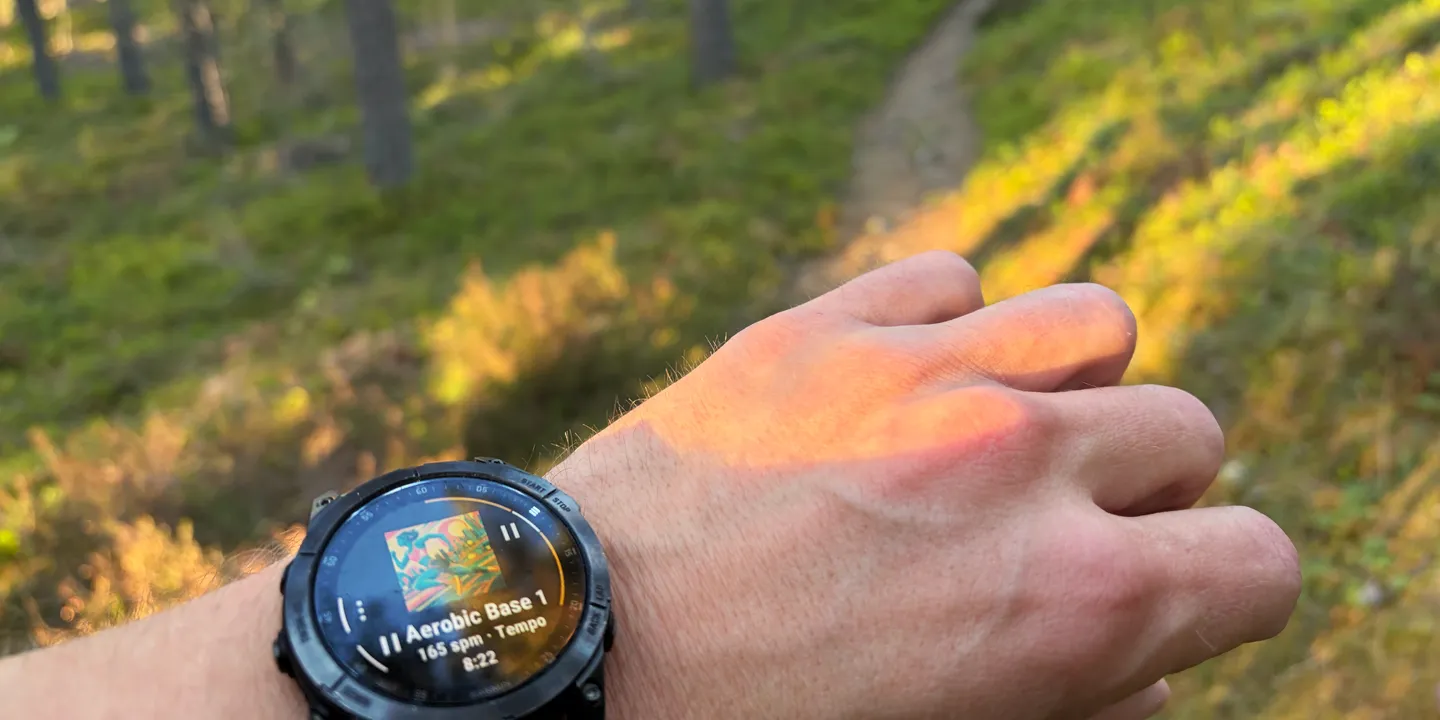
Every runner knows the feeling, even if they have never named it. You are ten minutes into a session, the legs are heavy, the brain is starting to negotiate an early exit, and then the beat locks to your stride. Not roughly. Exactly. Your feet land on the downbeat. Your breathing settles into it. The effort does not disappear, but it stops being the only thing you can think about. You just move.
That feeling is real, it is measurable, and it is the entire reason tempo-matched music works. But almost everyone chases it the wrong way, starting with a number that was never meant for them: 180.
Where 180 came from, and why it probably is not your number
The advice is everywhere. Run at 180 steps per minute. Find a 180 BPM playlist. Lock in.
It traces back to the coach Jack Daniels, who spent the 1984 Olympics counting the turnover of about 50 elite distance runners and found only one below 180 steps per minute. And he was no one-study wonder. He coached runners at every level for more than five decades, and his book “Daniels’ Running Formula” is about as close to a standard text as running coaching has. His reasoning was also better than the internet version suggests. He pushed quick turnover because it reduces overstriding and landing shock: shorter, quicker steps land closer to your center of gravity, and every footstrike hits softer. That part holds up well. Gait researchers have since confirmed that raising your cadence 5 to 10 percent above your own baseline reduces braking forces and the load on your knees.
Notice the phrasing, though: above your own baseline. Not “at 180.” The internet did the flattening, turning a coach’s shorthand for “quicken your steps if you overstride” into “180 or you’re doing it wrong.”
Because here is what the research since Daniels makes clear: cadence varies enormously between runners and says nothing about ability. A study of elite 100K runners found cadences ranging from 155 to 203 steps per minute, in the same race, at the same level. The researcher behind it, Geoff Burns, calls cadence “a barometer and not a governor.” Most recreational runners sit somewhere around 160 to 185 steps per minute, often lower on easy runs, and where you land depends mostly on your pace and your own ingrained mechanics. Height and leg length matter less than you would guess. A tall runner cruising an easy effort might be perfectly efficient at 162. Forcing that runner to 180 does not make them faster, it makes them take choppy little steps that feel awful.
And here is the part nobody mentions. Across the normal range of training paces, your cadence barely moves. Going faster shifts it by maybe five to ten steps per minute; the rest of the speed comes from stride length, not turnover. Daniels’ own data shows it: he cites an Olympic marathoner whose cadence rose only from 184 to 190 while his pace jumped from 7:00 to 5:00 per mile. Your cadence is more personal, and more stable, than the 180 rule implies.
To be fair to Daniels, he stood by the number to the end. The latest edition of his book still strongly emphasizes running at around 180. But the research stands by his principle, not his number: turnover quick enough that you are not overstriding. What “quick enough” means is relative to you.
Which completely changes how you should think about music.
Step one: find your actual cadence
Before you pick any music, spend one run finding your real number. Run at a comfortable, conversational pace and count your steps for 30 seconds, then double it. That is your base cadence. Most people are surprised. They have been told they should be at 180 and they are at 167, and 167 is fine.
That number, not 180, is the tempo your music should be built around. Match the beat to the cadence you actually have, and the entrainment effect does the rest.
Why the beat works at all
Quickly, the science, because it is genuinely interesting and it tells you how precise to be.
Your nervous system locks your footstrike to a steady beat automatically. Researchers call it auditory-motor synchronization, and it is involuntary. In controlled studies, when the music tempo is nudged up or down by a small amount, runners drift their cadence to follow it without noticing and without being told to. The beat becomes a metronome your body obeys before your conscious mind votes.
When the beat sits close to your real cadence, effort feels lower. Synchronous music has been shown to cut perceived exertion by around ten percent at easy-to-moderate intensities. But the effect lives inside a narrow window, roughly a couple of percent around your target. At 170, that is about 167 to 173. Outside that band, your body stops locking on and starts fighting the beat instead, and you lose the whole benefit.
This is why a “180 BPM” playlist that is actually full of 174 and 186 BPM tracks does nothing for you. Public BPM tags are notoriously wrong, and “close enough” lands you outside the window where any of this works.
Step two: think in three zones, not one tempo
Now the useful framework. A workout is not one effort, so it is not one tempo.
Walk through a normal interval session. The warmup, where you want the music settled and a touch under your base cadence so you do not charge out too hard. The work, where you want the beat right at your cadence to hold form. The recovery, where you want it to actually back off so you actually recover instead of being dragged along by an aggressive track. Three phases, three slightly different jobs for the music.
The shifts are small, remember, five to ten BPM, not dramatic gear changes. But small and right beats one flat tempo that is correct for a third of your run and slightly wrong for the rest. A single static playlist cannot be three answers. It plays your warmup, your hard reps, and your recovery at the exact same beat, which means it is fighting you for most of the session.
The bit that actually saves your workout
Here is the insight worth keeping even if you forget everything else. Late in a hard session, when you are tired, your form degrades and your cadence slips. Your steps get heavier and slower without you deciding to let them. That slow drift is where a lot of late-workout pace loss quietly comes from.
A steady, correct beat gives you something to hold onto exactly when you need it. It will not make the effort easier, the research is clear that above your threshold music stops masking pain. But it gives your tired legs a target, and holding cadence is far easier when something outside your head is keeping time. The beat does not carry you. It keeps you honest.
The cautionary tale: Spotify almost built this
Years ago Spotify had a feature called Running. It used your phone to detect your cadence, then played music near that tempo, and it even smoothed the transitions so the beat did not stutter between songs. For 2015 it felt like the future.
But it detected your cadence once and then held one static tempo for the whole run. It had no idea you were doing intervals, so it never lifted for a hard rep or settled for recovery. And for most of the catalog it picked songs that were roughly the right speed rather than locking them to an exact number. Then in February 2018 Spotify switched it off and never replaced it. Runners are still annoyed about it online, which tells you the itch it scratched was real, and that nobody fully scratched it since.
The lesson is not “Spotify bad.” It is that matching one tempo to your cadence was only ever the floor. The ceiling is music that follows the whole shape of the workout, at the exact tempo, in the zone where entrainment actually works.
So, the short version
Find your real cadence, ignore 180 unless it happens to be yours. Match your music to that number within a couple of percent, not “close enough.” Think in three small zones across a workout instead of one flat tempo. And lean on a steady beat most when you are tired and your form wants to fall apart.
You can absolutely build this by hand. Count your cadence, hunt down accurately tagged tracks, sort them into zones, sequence them by phase, and rebuild it every time your workout changes. It is a lot of work, and I did it for years, which is eventually why I built Beatpace to do it for me: it builds time-based mixes around your workout, locks each block to an exact tempo and energy, and runs native on Garmin so you can leave the phone at home. Fourteen days free if you want to skip the manual version.
Either way, stop running to 180 just because the internet told you to. Run to your number.
David is the founder of Beatpace and Runner Twelve AB, based in Sweden. He is a runner who reads too many exercise science papers and runs at 167, thanks for asking.
References
- Daniels. “Daniels’ Running Formula,” 4th edition. Human Kinetics, 2022. Human Kinetics
- Burns, Zendler & Zernicke. “Step frequency patterns of elite ultramarathon runners during a 100-km road race.” Journal of Applied Physiology, 2019. PubMed
- Heiderscheit, Chumanov, Michalski, Wille & Ryan. “Effects of step rate manipulation on joint mechanics during running.” Medicine & Science in Sports & Exercise, 2011. PubMed
- Karageorghis & Priest. “Music in the exercise domain: a review and synthesis (Part II).” International Review of Sport and Exercise Psychology, 2012. PMC