Why 130 BPM Feels Different Than "Close Enough"
The science behind tempo-matched training, and why approximate isn't good enough.
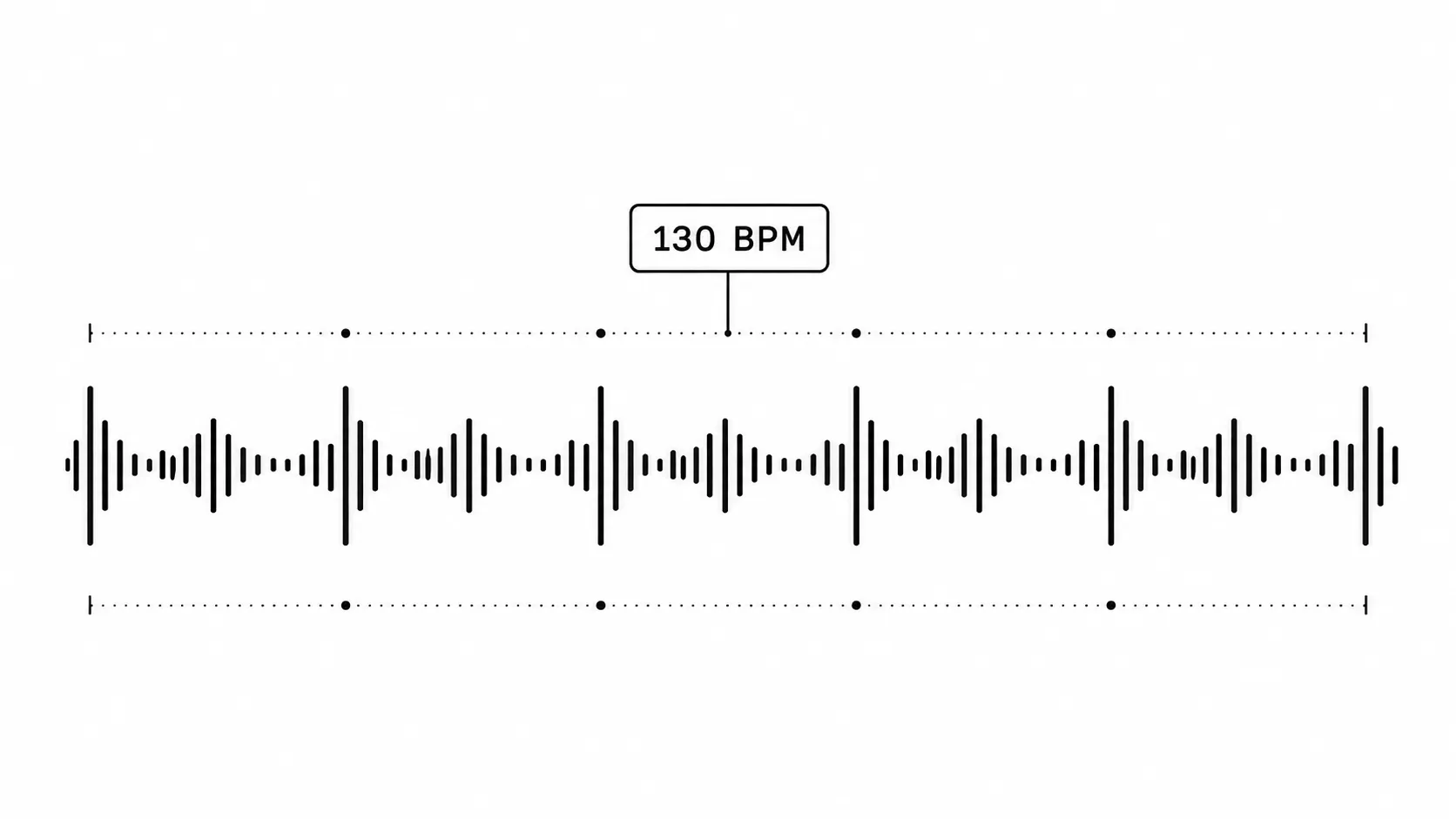
Every runner knows the moment. You’re ten minutes into an interval session, legs heavy, brain starting to negotiate an early exit, and then the beat locks to your stride. Not roughly. Exactly. Your feet land on the downbeat. Your breathing settles into the rhythm. The effort doesn’t disappear, but it stops being the only thing you’re aware of. You just… move.
That feeling has a name. Researchers call it auditory-motor entrainment, and three decades of peer-reviewed science say it’s not just in your head. It’s measurable, it’s neurological, and the difference between “roughly the right tempo” and “precisely the right tempo” is bigger than most people realize.
Your brain locks onto the beat whether you want it to or not
Here’s the part that surprised me most when I started digging into this research. Entrainment isn’t a choice. Your motor cortex, the part of your brain that plans and executes movement, activates in response to rhythmic sound even when you’re sitting still. Hear a beat, and your brain starts preparing movement to match it before you’ve consciously decided to do anything.
A study by Van Dyck and colleagues, published in Sports Medicine - Open in 2015, demonstrated this beautifully. They had recreational runners complete repeated 800-meter efforts while playing music that matched each runner’s natural cadence. Then they secretly shifted the tempo, up or down by tiny increments, 1% to 3%, well below the threshold of conscious detection. The runners adjusted their cadence to track the tempo shifts without any instruction to do so, and without realizing it was happening. Their bodies followed the beat automatically.
Waterhouse, Hudson, and Edwards found the same thing on bikes. Published in Scandinavian Journal of Medicine & Science in Sports in 2010, their study had cyclists ride while listening to music at normal tempo, secretly sped up 10%, or secretly slowed down 10%. None of the riders noticed the change. But when tempo increased, distance covered rose and power output climbed. When it decreased, performance dropped even more sharply, and enjoyment of the music fell off a cliff.
Your riders are already syncing to your music. The question is whether your music is syncing to your ride.
The numbers are hard to argue with
I’m a runner, not a scientist. But the data stopped me cold when I first encountered it.
Bacon, Myers, and Karageorghis published a cycling study in The Journal of Sports Medicine and Physical Fitness in 2012 that tested what happens when music BPM is locked precisely to pedal cadence, specifically, 130 BPM for a 65 RPM cadence, two beats per pedal revolution. Compared to music that was close but not matched, the synchronous condition reduced oxygen consumption by 7%. Same effort, same cadence, same duration, but the riders’ bodies used measurably less energy when the beat was exact.
Seven percent might sound small. It’s not. In a 45-minute class, that’s the metabolic equivalent of getting a free five minutes of work. Or, flipped: your riders can push harder at the same perceived cost.
Maddigan and colleagues took it further in 2019, publishing in PeerJ. They tested music at genuine high intensity, 80% of peak power output, the kind of effort where your legs are screaming. With 130 BPM music, cyclists lasted 10.7% longer than in silence. Their heart rates were higher. Their breathing was faster. By every physiological measure, they were working harder. But their perceived exertion was identical. They endured more without feeling like they were enduring more.
For runners, the numbers are even more dramatic. Terry, Karageorghis, and colleagues tested elite triathletes at the Queensland Academy of Sport, published in Journal of Science and Medicine in Sport in 2012. With tempo-matched music, runners lasted 18 to 19% longer before exhaustion compared to no music. And here’s the kicker: the motivational content of the music barely mattered. Neutral music with the right tempo produced slightly better results than motivational music with the right tempo. The beat did the heavy lifting, not the lyrics.
In 2020, Terry and Karageorghis published the field’s definitive meta-analysis in the APA’s Psychological Bulletin, 139 studies, nearly 3,600 participants, over a century of accumulated research. The verdict: music during exercise measurably improves mood, boosts physical performance, reduces perceived exertion, and improves oxygen efficiency. And faster music above 120 BPM consistently outperformed slower tempos.
An honest caveat
Music isn’t magic. The research is clear on this too.
Above roughly 75% of VO₂max, your anaerobic threshold, the point where breathing gets ragged and conversation becomes impossible, music largely stops reducing how hard the effort feels. The physiological signals become too loud for any external stimulus to mask. Karageorghis has acknowledged this ceiling effect across decades of work.
But here’s what’s interesting: even above that threshold, music still changes how riders respond to the pain. Maddigan’s study proved it. At 80% peak power, music didn’t make the effort feel easier, but riders kept going longer anyway. Music colours the experience of fatigue even when it can’t hide it. For an instructor designing a class with sprint intervals, that distinction matters. The hard blocks don’t need to feel easy. They need to feel worth pushing through.
So what does this mean for your class?
If you’re an instructor reading this, you already intuitively know most of what I just described. You know a great playlist transforms a class. You know a badly timed song kills momentum. What the research adds is specificity about where the magic lives, and it’s in precision most playlists can’t deliver.
The 2:1 BPM-to-RPM ratio. A 65 RPM cadence needs 130 BPM, not 127 or 134. The Van Dyck study showed entrainment is strongest within about 2% of target tempo. At 130 BPM, that’s roughly 127 to 133. Outside that window, your riders’ nervous systems start fighting the beat instead of riding it.
Continuous rhythm matters. Entrainment works because the brain builds anticipatory timing templates. It predicts when the next beat lands and pre-plans the corresponding muscle activation. A gap between tracks, a jarring tempo shift, a transition that doesn’t land on the beat: each one breaks that template and forces the brain to rebuild it from scratch.
Energy matching across phases matters. Emerging research from Karageorghis’s lab suggests that matching music tempo and intensity to each phase of a workout, slower and calmer for recovery, faster and harder for work intervals, facilitates both better recovery between efforts and stronger performance during them.
This is why I built Beatpace to lock BPM to your ride profile block by block, crossfade on the beat so the entrainment state never breaks, and match music energy to each phase of your class. Not because it’s a cool feature, but because the science says precision here is the difference between a good class and the class your riders can’t stop talking about.
If you’re curious what that sounds like, come try it at beatpace.io.
David is the founder of Beatpace and Runner Twelve AB, based in Sweden. He’s a runner who reads too many exercise science papers and is building the music tool he wished existed for his own training.
References
- Bacon, Myers & Karageorghis. “Effect of music-movement synchrony on exercise oxygen consumption.” The Journal of Sports Medicine and Physical Fitness, 2012. PubMed
- Waterhouse, Hudson & Edwards. “Effects of music tempo upon submaximal cycling performance.” Scandinavian Journal of Medicine & Science in Sports, 2010. Wiley
- Maddigan, Sullivan, Halperin, Basset & Behm. “High tempo music prolongs high intensity exercise.” PeerJ, 2019. PeerJ
- Van Dyck, Moens, Buhmann et al. “Spontaneous Entrainment of Running Cadence to Music Tempo.” Sports Medicine - Open, 2015. SpringerOpen
- Terry, Karageorghis, Mecozzi Saha & D’Auria. “Effects of synchronous music on treadmill running among elite triathletes.” Journal of Science and Medicine in Sport, 2012. ScienceDirect
- Terry, Karageorghis, Curran, Martin & Parsons-Smith. “Effects of Music in Exercise and Sport: A Meta-Analytic Review.” Psychological Bulletin, 2020. PubMed
- Karageorghis, Mouzourides, Priest et al. “Psychophysical and ergogenic effects of synchronous music during treadmill walking.” Journal of Sport & Exercise Psychology, 2009. PubMed